
Spin-transfer torque magnetic random-access memory (STT-MRAM) is increasingly used for embedded and standalone non-volatile memory applications, including automotive, industrial, and edge-computing systems. Because STT-MRAM stores information in the magnetic state of a magnetic tunnel junction (MTJ), an important reliability question is its sensitivity to external magnetic fields.
What is magnetic immunity in STT-MRAM?
STT-MRAM stores data by switching the magnetization of a magnetic free layer between two stable states. During normal operation, the magnetic stability of this layer is designed to be high enough to prevent unwanted switching caused by external magnetic fields.
The resistance of an STT-MRAM cell depends on the relative orientation of the free layer and reference layer. During a write operation, a spin-polarized current generates spin-transfer torque, switching the free-layer magnetization and therefore changing the stored state.
An external magnetic field can interact with this magnetic structure. Depending on its strength, direction, temperature, and timing, it can modify the switching conditions of the memory cell and potentially affect write reliability.
This resistance to external magnetic fields is commonly referred to as magnetic immunity or magnetic robustness.
How much external magnetic field can STT-MRAM withstand?
Modern STT-MRAM technologies are designed to tolerate magnetic fields significantly higher than those normally encountered in most operating environments.
The magnetic stability of the free layer is typically associated with coercive fields in the range of hundreds of millitesla, while the practical magnetic immunity specified for commercial STT-MRAM products is generally in the range of several tens of millitesla up to around 100 mT, depending on the technology and application.
The most critical conditions are generally found during write operations, particularly at low temperature. At low temperature, the magnetic stability of the free layer increases and a higher write current may be required. An external magnetic field opposing the intended switching direction can therefore reduce the available switching margin.
For this reason, magnetic immunity cannot be evaluated simply by measuring whether a memory cell remains stable in standby. A meaningful characterization must also investigate the impact of magnetic fields on the write operation and memory error rate.
Why test STT-MRAM under external magnetic fields?
As MRAM moves into demanding applications such as automotive electronics, industrial systems and advanced embedded memory, understanding magnetic robustness becomes an important part of device qualification and technology development.
Magnetic field testing can be used to:
- Determine the maximum magnetic field that an MRAM device can tolerate.
- Characterize magnetic immunity in different field directions.
- Evaluate write errors under external magnetic fields.
- Study the impact of temperature on magnetic robustness.
- Identify the most sensitive operating conditions.
- Compare different MRAM technologies, processes or device generations.
- Support reliability qualification and design optimization.
How is MRAM magnetic immunity characterized?
A controlled magnetic field must be applied to the device while its electrical operation is monitored. The test system needs to provide a precisely controlled magnetic field while allowing the MRAM to be electrically operated and its memory behavior to be measured.
For advanced STT-MRAM characterization, a useful test methodology combines:
Controlled 3D magnetic fields
Magnetic immunity can depend on the orientation of the applied field. Testing along multiple axes therefore provides a more complete picture of device robustness.
Electrical device testing
The MRAM must be operated while the magnetic field is applied so that read and write behavior can be monitored directly.
Temperature control
Because magnetic stability and switching conditions vary with temperature, magnetic immunity should be evaluated across the relevant operating temperature range.
Automated field sweeps and error detection
Automating magnetic-field sweeps and electrical measurements makes it possible to identify magnetic immunity limits efficiently and repeatably.
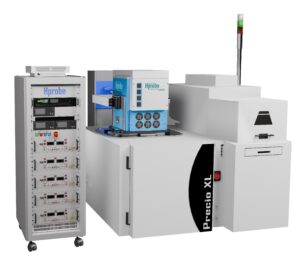
Hprobe solutions for MRAM magnetic immunity testing
Hprobe develops magnetic test equipment designed for the characterization of magnetic semiconductor devices, including MRAM.
Hprobe systems combine precise magnetic field generation, electrical device testing and automation to enable controlled evaluation of MRAM behavior under external magnetic fields.
This approach allows semiconductor manufacturers, memory developers and research organizations to characterize magnetic immunity from device development through technology qualification.
As MRAM technologies continue to evolve, controlled magnetic-field testing provides a practical way to understand their robustness, optimize switching margins and validate performance in demanding operating environments.
Hprobe provides magnetic test solutions for advanced MRAM characterization and magnetic immunity testing.