
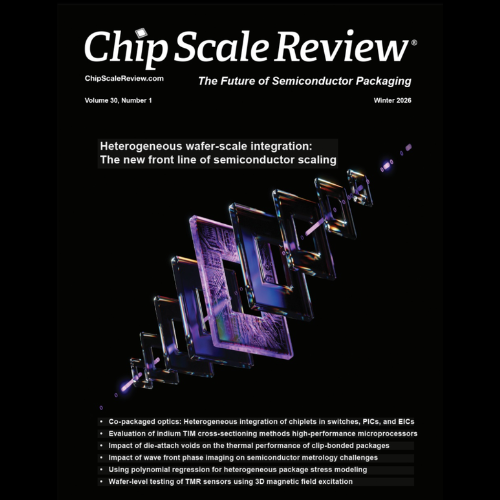
In the latest issue of Chip Scale Review, Siamak Salimy, CTO and Co-Founder of Hprobe, explains why Tunnel Magnetoresistance (TMR) is becoming the fastest-growing magnetic sensor technology — and why its rapid adoption is redefining wafer-level testing requirements.
Driven by electrification, automation, ADAS, robotics, consumer electronics and medical applications, demand for higher performance magnetic sensing continues to accelerate. Among existing technologies such as Hall, AMR and GMR, TMR stands out for its exceptional sensitivity. With magnetoresistance ratios exceeding 100% and microtesla detection capability, it enables major performance gains in precision, power efficiency and miniaturization.
However, these advantages also introduce significant production challenges. The very sensitivity that makes TMR attractive requires extremely precise magnetic field control during wafer-level characterization. Manufacturers must be able to measure minor and major loops across a wide range of field strengths, from microtesla to hundreds of millitesla, while ensuring full 3D magnetic field control along the X, Y and Z axes. At the same time, field accuracy, uniformity, sweep speed and throughput must meet strict production constraints.
As sensitivity increases, tolerances shrink. As volumes grow, throughput pressure intensifies. Ensuring repeatability and stability under real production conditions becomes critical, especially when closed-loop calibration is required at wafer level.
Dedicated 3D magnetic field excitation systems are emerging as a key enabler. By combining precise vector field control with production-ready integration, they allow accurate, high-throughput wafer-level characterization that can scale from R&D environments to full manufacturing.
As TMR adoption accelerates across industries, the challenge is no longer just about sensor performance — it is about the ability to test that performance reliably and efficiently at scale.
Hprobe, part of Mycronic, supports magnetic sensor manufacturers in addressing these production realities with proven 3D magnetic test technology designed specifically for wafer-level applications.
Read the full article in Chip Scale Review (pp. 42–44).